

Arc Fault Event Report
Arc Fault Event Building Protection
A Gas Insulated Switchgear unit houses a gas filled compartment. If an arc fault occurs in this compartment, the heat generated will cause the insulating gas to expand, causing an overpressure. In order to protect the compartment from structural failure, a burst or rupture disk is commonly installed and set to burst at a set safety pressure. In situations where this allows the expanded gas to discharge directly into a substation, structural damage can occur.
After some examples of real world substantial building damage, it is now common for blast vents to be installed in buildings housing GIS units.
In order to design and supply the correct types of vents for these types of discharges, AFPAir Tech Ltd built a live test 'Blast Simulator' in order to simulate a GIS rupture disk event and to also to monitor how an AFP blast vent operates during it.
Blast Simulation
There is no standard or testing protocol for blast venting in these exact circumstances and this is why AFP has built its Blast Simulator to mimic these types of extremely rapid pressure discharges and designed our own testing standard for blast vents.

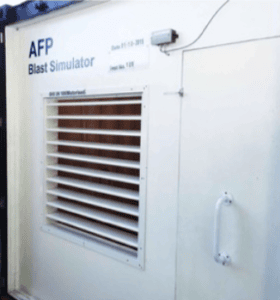
The AFP Blast Simulator has been built to simulate a variety of switchgear gas cooled compartments with volumes up to 1.8m3. It can operate at pressures up to 10bar to recreate rupture disk burst settings up to this pressure, and also has output orifices up to 150mm to represent varying rupture disk diameters.

This produces the same instant pressure discharge as can be produced during a switchgear fault, with a typical total discharge time of between 0.1 and 0.2 seconds. When the correct sized AFP SHX UN Blast vents are installed, this results in the time to peak pressure, in the building, being suppressed to just 0.06 seconds which has the effect of massively reducing any potential overpressure that could result in structural damage.

By monitoring the pressure in the pressure cylinder, the test container and also the position of the blast vent blades at 20HZ, the relationship between the rates of gas volume increase in the test container, verses the rate at which the blast vent blades open, can be associated with the peak pressure in the container.

The data collected from the AFP live discharge tests can also be integrated into the
results produced by certain software simulations. Most of the simulations we have seen do not take into account the rate at which the blast vent opens, in the 0.01s increments needed to fully assess how the over pressure relates to the free vent area of the vents over time. This now means that thanks to AFP blast testing, the theoretical simulations can finally be matched up to an expected discharge from the 'real world*

The SHX-UN Pressure/Blast vent also comes in a motorised version so as to provide ventilation if so required.
SHX UN 700 MOT FVA Over Time Discharge Tests
Typically an SHX UN blast vent fully opens in80ms during a blast simulation discharge. Test 217 was done in a43m3 steel container. Compressed air was discharged into the container from a 1.8m3 pressure chamber via a 150mm diameter air cannon with an 'instant open' valve. Vent used was an SHX UN 700 MOT (without a motor). This unit was used because it has a linkage that connects all of the blades together which could be used to measure the blade opening in unison.
During the discharge, we were able to utilise this data to measure the exact position of the blades and therefore establish the free vent area over time.

Discharge no. 217


Vent Blade Position Over Time
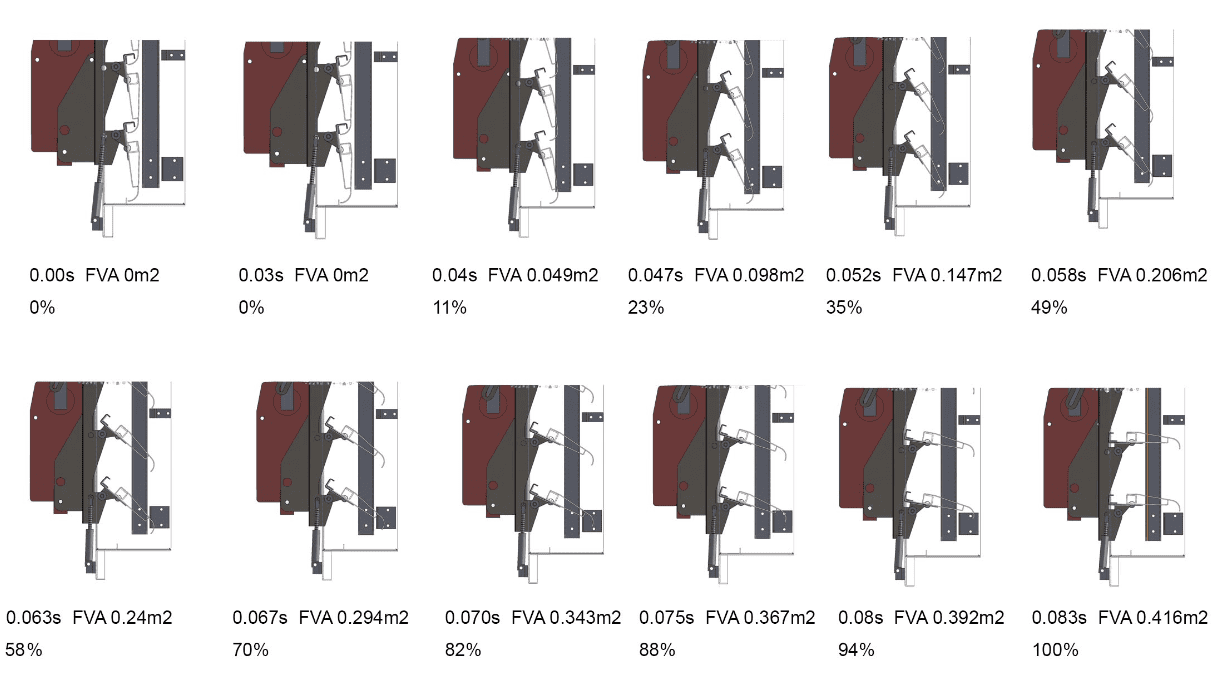
Graph of potential non vented pressure, actual measured pressure and FVA of vent over time.

The SHX UN range has also been Gas Ignition explosion tested. Using a high speed camera they have been measured to fully open in 11ms with no structural failures at non vented enclosure test pressure of up to 20 bar (oxygen/acetylene mix).

Certified fire tested to 4 hours for all sizes.

Environment testing of all of our external louver units, which have been proven to give superb external weather protection.
