Motorised pressure relief vents explained
26th January 2026
Why standard pressure relief vents are your best choice
26th March 2026

Inert vs. chemical gas venting: Pressure relief considerations for gas fire suppression
Not all gas fire suppression systems behave the same, and neither should their venting. Inert and chemical agents create very different conditions inside an enclosure during discharge: from the rate and volume of gas to the way pressure rises and falls.
The right venting solution must be tailored to the type of gas used, ensuring that walls, ceilings, doors, and equipment are protected throughout both the discharge and cooling phases. In this article, we explore how venting requirements differ for inert and chemical gas systems, and what it means for safe, effective pressure relief.
The role of pressure relief in gas fire suppression systems.
In any gas fire suppression system, the discharge of agent into a sealed enclosure creates a rapid pressure rise. That pressure must be managed. Without controlled relief, the force generated during discharge can exceed the structural limits of the room.
This is where pressure relief venting comes in. Vents provide a designed pathway for expanding gases and displaced air to escape, helping maintain structural stability while preserving the room’s protective function. The relationship between venting and room integrity is critical: the enclosure must be tight enough to hold the agent, yet capable of safely withstanding the temporary pressure changes caused by discharge.
Inert gas venting: characteristics and challenges
Inert gas fire suppression systems extinguish fire by reducing oxygen levels within an enclosure. Common inert gases include:
- Nitrogen (IG-100)
- Argon (IG-01)
- IG-55 (Argon/Nitrogen blend)
- IG-541 (Nitrogen/Argon/CO₂ blend)
Inert agents are stored at high pressure and released in bulk to achieve the needed concentration. Therefore, the rate and volume of flow during discharge are significantly higher than with manu chemical agents.
This high mass flow rate places substantial stress on walls, ceilings and doors during discharge. If the pressure is not relieved quickly enough, structural elements can be exposed to forces beyond their design limits.
The right venting solution for inert gases
The right venting solution must accommodate high mass flow and rapid pressure rise while ensuring the room retains its integrity once the event is over. Venting for inert gas systems must therefore:
- Respond rapidly at the defined opening pressure.
- Provide sufficient free vent area for high airflow.
- Withstand the mechanical loads generated during discharge.
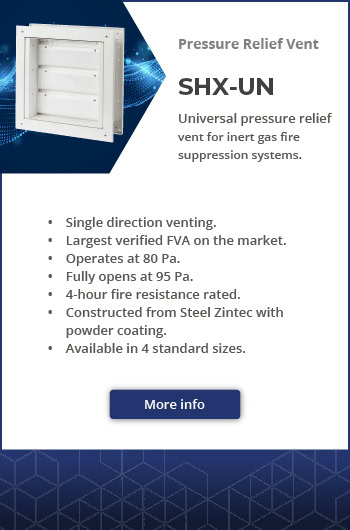
For inert gas applications, pressure relief vents such as the SHX-UN are engineered specifically to manage these conditions. The SHX-UN’s design allows it to open at the required set point and provide the necessary relief capacity for inert systems without compromising structural stability.
Chemical gas venting: characteristics and challenges
Chemical gas fire suppression systems extinguish fire by absorbing heat and interrupting the combustion process. Common chemical agents include:
- HFC-227ea (FM-200)
- FK-5-1-12 (Novec 1230)
Unlike inert gases, chemical agents are stored as liquids and discharged in a way that results in a lower overall mass flow into the enclosure. During release, a positive pressure spike can still occur and must be relieved.
The key distinction between inert and chemical gas suppression lies in what happens next.
When the fire is extinguished, the temperature inside the enclosure begins to fall. As the gas agent cools and stabilises, it contracts. This reduction in volume creates a negative pressure phase within the room — effectively a temporary vacuum condition.
The resulting inward pressure load pulls on walls, ceilings, doors and other structural elements. If sufficient make-up air is not allowed to enter the enclosure in a controlled manner, this negative pressure can compromise room integrity and place stress on the building structure.
The right venting solution for chemical gas
Venting for chemical gas systems must therefore account for both positive and negative pressure phases. The venting solution must:
- Open at the defined positive pressure set point.
- Provide sufficient relief during discharge.
- Allow controlled inward airflow during the negative pressure phase.
- Maintain enclosure integrity once pressures stabilise.
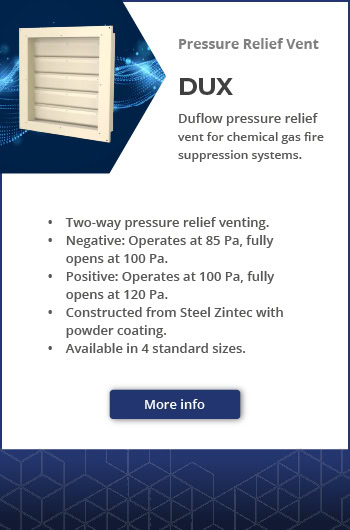
For chemical gas applications, pressure relief vents such as the DUX are specifically engineered to manage bi-directional pressure events.
The DUX is designed to open at the defined set point in both directions — relieving excess pressure during discharge and allowing controlled make-up air to enter the enclosure during the negative pressure phase. This ensures that pressure is balanced throughout the entire suppression event, helping to maintain room integrity before, during and after discharge.
Key differences between inert and chemical gas venting
Although both systems require pressure relief venting to maintain room integrity, the behaviour of the agent during and after discharge creates distinct venting requirements.
| Inert Gas Systems | Chemical Gas Systems | |
| Pressure profile | Dominated by a rapid, high positive pressure spike. | Positive pressure during discharge followed by a negative pressure phase. |
| Structural load on walls and ceilings | High outward load during discharge. | Outward load during discharge, inward load during cooling phase. |
| Airflow volume | Large mass flow and high airflow volume. | Lower mass flow compared to inert systems. |
| Direction of venting | Primarily outward (positive pressure relief). | Bi-directional (positive and negative pressure relief). |
| Vent requirements | Large free vent area, fast response, robust construction. | Controlled set points in both directions, balanced airflow management. |
| Design focus | Managing peak discharge forces. | Managing pressure balance throughout the full discharge cycle. |
AFP’s pressure relief solutions for inert and chemical gas suppression
Proper venting is essential for both inert and chemical gas systems, but the underlying challenges are very different. Inert gas systems require vents that can handle high-volume, rapid positive pressure, while chemical gas systems must manage both positive and negative pressure phases. Understanding these differences is critical to maintaining room integrity and ensuring that the protected space and its contents remain safe throughout a suppression event.
AFP’s pressure vents are engineered specifically with these requirements in mind. Vents such as the SHX-UN are designed for inert gas applications, providing rapid relief during peak positive pressures. For chemical gas systems, vents like the DUX manage bi-directional pressures, ensuring controlled airflow both out of and into the room.
By focusing solely on pressure vents, AFP offers purpose-built solutions that are tested, reliable, and tailored to the specific behaviour of the gas agent, helping system designers and facility managers safeguard both structures and assets.