
What is a gas fire suppression system and how does it work?
26th September 2024
What is the best fire suppression system for electrical rooms?
26th November 2024

How does pressure relief venting work in a gas fire suppression system?
In any critical environment where fire safety is paramount, gas fire suppression systems offer an effective solution. However, few realize that for these systems to function optimally, there’s another crucial element at play: pressure relief venting.
Without pressure relief venting a suppression discharge causes the pressure to rise so high that it can cause damage to the enclosure.
In this article, we explain further how pressure relief venting works and why it is essential for every gas fire suppression system. Read on to discover everything you need to know about protecting your enclosure and maintaining fire safety.
What is pressure relief venting?
In a gas fire suppression system, pressure relief venting ensures that the sudden release of gas, in the event of a fire, doesn’t cause structural damage.
When the gas is discharged to suppress a fire, it builds up pressure inside the sealed space. Pressure relief vents are designed to release this excess pressure safely, ensuring the enclosure’s integrity remains intact while the fire suppression system does its job.

Why is pressure relief venting important for a gas fire suppression system?
For gas-based fire suppression to be effective, the enclosure must be airtight. If the gas leaks into surrounding areas, it loses concentration and its ability to suppress fire diminishes.
However, tightly sealing an enclosure also creates a challenge. When the gas is released, it rapidly builds up pressure that could damage the walls, windows, or even the entire structure. That’s where pressure relief vents come in.
These vents control the release of excess pressure, ensuring the space remains undamaged, and the system continues to function as intended.
How does pressure relief venting work?
Pressure relief venting is possible by installing a pressure relief vent in the wall, door, or ceiling of the enclosure. Pressure relief vents are designed to activate automatically when the pressure in a room reaches a certain threshold.
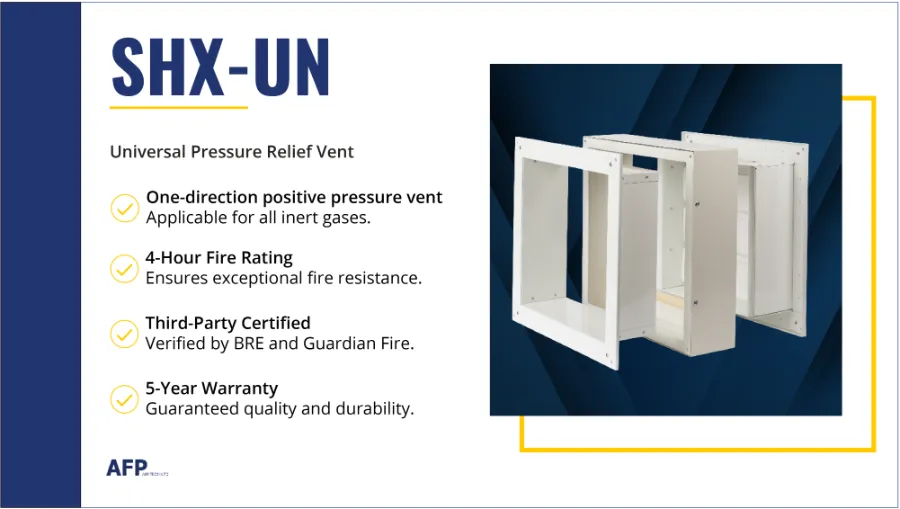
Take our SHX-UN vent, for example. When a gas discharge occurs, the vent opens automatically to release the excess pressure. Once the pressure stabilizes, the vent closes to maintain the room’s integrity.
This ensures the gas stays concentrated inside the enclosure, effectively suppressing the fire. You can see exactly how the SHX-UN vent operates in the video below, demonstrating its efficiency and reliability in action.
Different types of pressure relief vents
Pressure relief vents come in various designs, each suited to different fire suppression methods. Whether using inert gas or chemical gas, AFP’s vents are engineered to maintain the balance between room integrity and pressure relief.
Inert gas pressure relief vents
Inert gases like nitrogen and argon suppress fires by displacing oxygen, smothering the flames. Since these gases don’t expand significantly, only a one-way pressure relief vent is needed for inert gas systems.
Our SHX-UN vent is perfect for this application, as it efficiently releases the minimal excess pressure generated during an inert gas discharge while ensuring the enclosure remains sealed.
Chemical gas pressure relief vents
Chemical fire suppressants work by interrupting the chemical reactions of fire. These gases expand more rapidly, creating greater pressure inside the enclosure, which is why positive pressure venting is necessary. However, with chemical gases, you must also be aware of the vacuum effects that can occur when external conditions change (e.g., cooling of gases, gas withdrawal, or external vacuum events). This vacuum effect makes negative pressure relief venting essential to prevent potential structural collapse or deformation of the enclosure.
To properly vent chemical gas, you need a two-way vent, able to both relief positive and negative pressure within an enclosure. Our DUX is the world’s first two-way pressure relief vent and provides a level of performance not otherwise available for this application. The two pivot design, with adjacent blades interlocking, offers superior fire protection with low overall leakage and unique pressure relief efficiency.

Determining the right size of your pressure relief vent
The right size of a pressure vent depends on the Free Vent Area (FVA). This dictates how many vents and what size is required for your enclosure.
Typically, your gas suppression system supplier will provide you with the necessary gas calculations, which include the FVA. Alternatively, you can obtain the FVA through an integrity test.
It’s worth noting that if you’re relying on natural leakage as part of your FVA calculation, ISO recommends regular integrity tests to account for any changes over time.
ISO TS 21805
ISO TS 21805 provides guidance on calculating the FVA. According to section 7.8.2, “The required pressure-relief vent area depends on the maximum mass flow rate of agent, w. The maximum flow rate, w, depends on the discharge time, t, and the design of the discharge valve.” Accurate calculations ensure your pressure relief vents are capable of handling the pressures generated during gas discharge.
AFP pressure relief vents
At AFP Air Tech Ltd, we pride ourselves on being the world leaders in pressure relief venting solutions. Our products undergo rigorous third-party testing to ensure they meet the highest standards of safety and performance.
When you choose AFP pressure relief vents, you’re choosing the best possible protection for your enclosure and your gas fire suppression system.
Most of AFP’s pressure relief vents, including our flagship products SHX-UN and DUX, have been third-party tested to ensure they meet the highest safety standards.
4-hour fire rating
One of the key features of our vents is their 4-hour fire rating, verified through independent testing. This ensures that, even in the event of a prolonged fire, our pressure relief vents will maintain their integrity, providing critical protection to your enclosure.
Globally recognized safety standards
In addition to fire ratings, our vents comply with ISO TS 21805, NFPA (National Fire Protection Association) standards, and EN guidelines, all of which are globally recognized for their rigorous safety requirements in gas fire suppression systems.
Extreme pressure
Beyond third-party certifications, we test our pressure relief vents in-house for extreme conditions using our state-of-the-art blast simulator. This simulator replicates high-pressure scenarios, ensuring our vents can withstand sudden and intense pressure changes, such as those caused by arc fault events or gas discharges.
This additional testing reinforces the durability and performance of AFP vents in real-world, high-pressure environments.