What is the best fire suppression system for electrical rooms?
26th November 2024
Protecting Against Arc Flash and Arc Blast: Why Pressure Relief Vents Matter
26th January 2025

Room Integrity: The Essential Guide to Protecting Your Gas Fire Suppression System
Ensuring the safety and functionality of a gas fire suppression system goes beyond selecting the right gas or installing quality equipment. A critical, yet often overlooked factor, is room integrity. Without it, even the best fire suppression systems can fail, leaving your property and people at risk.
This guide explains what room integrity is, why it matters, and how to assess it through room integrity testing. By the end, you’ll understand the role of pressure relief vents and how AFP’s solutions can help you maintain airtight protection for your enclosures.
What is room integrity?
Room integrity, or enclosure integrity, refers to the ability of a room or enclosure to contain the suppression gas effectively during and after discharge. For gas fire suppression systems, such as those using IG-55 (a nitrogen-based inert gas) or Novec 1230 (a chemical agent), the room must be airtight to achieve the desired fire suppression effect.
Why air tightness integrity matters
Suppression agents work by either displacing oxygen (inert gases) or inhibiting the chemical reactions that sustain a fire (chemical agents). If the room is not airtight, gas can escape, making it more difficult to achieve the concentration required to suppress the fire. As a result, this leakage can lead to:
- Fire suppression failure: The fire may not be fully extinguished.
- System inefficiency: More gas may be required to compensate for leakage.
- Resurgence: Fire resurgence can occur due to insufficient suppression.
Air tightness of the room, prevents gas leakage and ensures the fire suppression system operates effectively, safeguarding personnel, the structure and its contents.
What is a room integrity test?
Room integrity testing evaluates whether an enclosure can maintain the suppression gas concentration long enough to extinguish a fire. It is a professional assessment conducted by integrity testing services, using specialised equipment. This test is critical for ensuring that your gaseous fire suppression system will perform as intended in the event of a fire.
Room integrity test procedure
Room integrity testing involves the following steps:
- Preparation: Before the test begins, all doors, windows, and other openings in the room are sealed. Technicians ensure the room is cleared of personnel for safety reasons and that any HVAC systems are appropriately shut down or accounted for.
- Pressurisation: Using a high-powered blower door fan system, air is introduced into the room to pressurise it, mimicking the conditions that occur when suppression gas is discharged. This specialised equipment can measure air pressure changes with extreme precision.
- Leakage measurement: The equipment detects how much air escapes through unintentional openings, such as cracks, poorly sealed joints, or penetrations for cables and pipes. The data collected helps to quantify the room’s natural leakage rate.
- Retention time calculation: Advanced software analyses the leakage data to calculate how long the suppression gas would remain in the room at a concentration high enough to suppress the fire.
Factors such as structural modifications, construction defects, or the natural ageing of materials can increase leakage rates. As these changes occur, adjustments may be necessary — such as resealing gaps, upgrading vents, or making other modifications to the room — to ensure that the room maintains sufficient integrity for the gas fire suppression system to function effectively when needed.
Annual testing ensures compliance with industry standards, helps identify potential issues early, and keeps the fire suppression system ready for effective operation.

What is the outcome?
The results of a room integrity test provide two key metrics:
Retention time
Retention time indicates the hold time. In other words, how long the suppression gas will stay at the required concentration level to extinguish a fire. This is vital because most fire suppression systems are designed to suppress a fire within a specific time frame.
If the retention time is too short, it may indicate the room is too leaky for the system to function effectively. In the UK, the minimum retention time (or minimum hold time) of a room integrity test is typically specified by the British Standard BS ISO 14520-1:2015, which covers gaseous fire suppression systems.
Natural leakage rate
The natural leakage rate measures the unavoidable air leakage in the room, typically expressed as a volume flow rate (e.g., cubic metres per hour). This information helps identify areas where additional sealing may be required.
It also plays a crucial role in determining the specifications for pressure relief vents, ensuring that over-pressurisation or under-pressurisation issues are managed effectively.
Using the results
The data from a room integrity test serves several purposes:
- Compliance: Ensures the enclosure can hold the correct concentration to meet safety standards for fire suppression systems, which is essential for legal and insurance requirements.
- System optimisation: Helps determine if additional measures, such as sealing gaps or upgrading pressure relief vents, are needed to enhance performance.
- Vent sizing: The leakage data is used for calculating the appropriate size and type of pressure relief vents required to maintain balance during gas discharge. Proper vent sizing prevents damage to the enclosure while maintaining the integrity needed for effective fire suppression.
- Long-term maintenance planning: Regular testing and monitoring of results over time allow you to track changes in room integrity and address any emerging issues, such as wear and tear on seals or structural modifications.
By investing in regular room integrity testing, you ensure that your gas fire suppression system is not just installed, but fully functional and ready to perform when required.
Room integrity during discharge
Room integrity is crucial not only to ensure that the gaseous agent can build up the necessary concentration to suppress a fire, but also to manage the pressure generated during gas discharge. Without proper control, the rising pressure can cause structural damage to the enclosure, such as cracked walls or broken seals. This damage can result in excessive gas leakage, compromising the performance of the suppression system.
The best approach is to fully seal the room and incorporate pressure relief venting to prevent structural failure. This ensures maximum gas retention, allowing the suppression system to maintain its effectiveness. At the same time, the vents protect the building structure from the damaging effects of both overpressure and underpressure, preserving the room’s integrity during gas discharge.
By maintaining both the room’s physical structure and its ability to retain the gas, pressure relief vents play an essential role in ensuring the overall effectiveness of the fire suppression system.

Maintain room integrity with AFP pressure relief vents
AFP specialises in providing high-quality pressure relief vents that are essential for maintaining room integrity in gas fire suppression systems. Our products are designed to offer optimal performance, reduce leakage, and ensure that the system works as intended to protect your property and assets.
Once the pressure in the room reaches a certain threshold, AFP pressure relief vents open to release excess pressure and prevent structural damage. This typically occurs during the discharge of suppression gas, when the pressure in the room rises to levels that could compromise the room’s integrity.
After the pressure has subsided to a safe level, the vents automatically close to maintain both the room’s seal and the gas concentration. Unlike natural leakage, such as gaps in walls, which is constant and unpredictable, AFP vents provide reliable protection against both overpressure and underpressure, ensuring the suppression system remains effective.
Below is a closer look at our range of pressure relief vents and why they are the right choice for different environments.
SHX-UN vent: Ideal for IG-55 systems
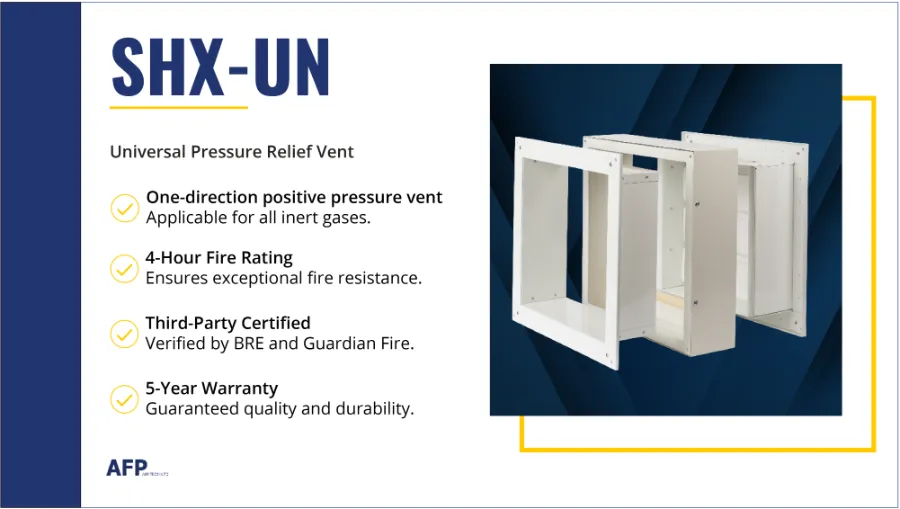
For environments using IG-55 (Nitrogen-based inert gas) systems that require one-way venting for positive pressure relief, the SHX-UN vent is the ideal solution.
- One-way venting: This system allows pressure to escape in the event of over pressurisation and is designed to open and close at precise pressure levels. While the SHX-UN allows for minimal leakage, it is engineered to ensure that this does not interfere with the room’s integrity. Only using natural leakage, is unpredictable and cannot reliably handle sudden changes in pressure.
- IP54 certification: The DWP is an IP54 cat II sealed panel. When the SHX-UN is used in conjunction with the DWP, a 100% seal can be achieved for rooms where 0 leakage is required. The DWP also offers a high level of protection against dust and water ingress, making it ideal for environments with high humidity or potential exposure to the elements.
- When to use: The SHX-UN pressure relief vent is designed for inert gas suppression systems, with low to moderate leakage requirements.
DUX Duflow vent: Best for large enclosures with Novec systems

For large enclosures using Novec chemical gas systems (clean agent), the DUX Duflow vent is the preferred choice. This vent is built to handle both positive and negative pressure relief and is designed for larger spaces where the pressure build-up during gas discharge can be more significant.
- Two-way pressure relief: The DUX vent can manage both positive and negative pressures, ensuring that both overpressure and vacuum conditions are safely managed.
- Minimal leakage: While the DUX vent allows for minimal leakage, it is engineered to ensure that this does not interfere with the room’s integrity. The small amount of leakage is normal for pressure vents and typically does not cause the room to fail the integrity test.
- When to use: Ideal for large rooms where both positive and negative pressures are a concern, and where efficient venting during gas discharge is required.
DMX vent: The solution for small rooms needing zero leakage
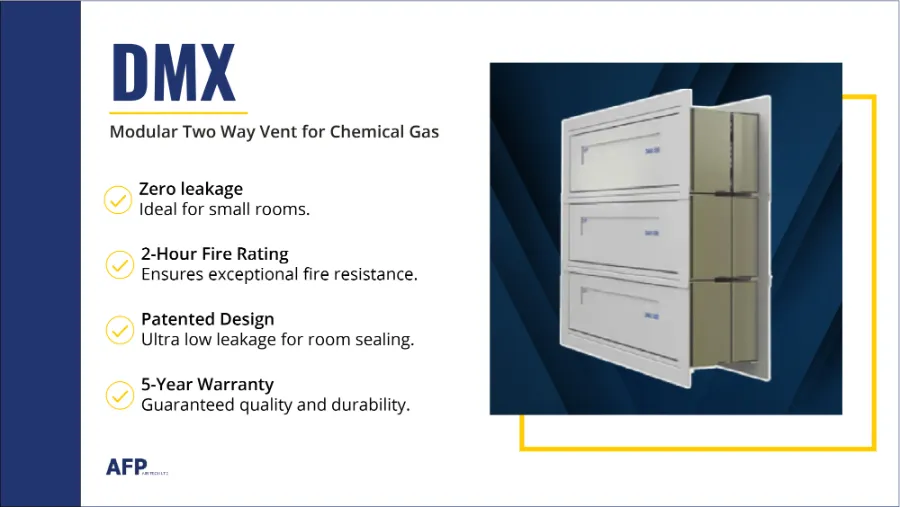
Small rooms using Novec can be particularly challenging when it comes to maintaining the required clean agent concentration for fire suppression.
The DMX pressure relief vent is specifically designed for these scenarios and ensures zero leakage when closed. This makes the DMX vent an ideal choice for Novec systems, where very low to zero leakage is critical for passing room integrity tests.
- Zero leakage design: The DMX vent has a complete perimeter seal, without gaps around the blades, which ensures that no gas escapes when the vent is closed.
- Effortless pressure release: Despite its completely sealed construction, the DMX vent opens at 100 Pa pressure, ensuring that overpressure is safely released during the discharge of the suppression agent.
- When to use: Best suited for small, high-seal environments where gas retention is critical, and leakage needs to be minimised to meet strict testing requirements.
Get in touch
Room integrity is a cornerstone of effective gaseous fire suppression systems. By understanding its importance, conducting regular testing, and using high-quality pressure relief vents, you can ensure optimal protection for your enclosures.
With AFP’s innovative vent solutions, you can maintain room integrity and protect both your assets and your fire suppression investment. Reach out to us today to explore the best pressure relief vents for your fire suppression system.