How to ensure long-term vent performance in unmanned locations?
26th November 2025
Motorised pressure relief vents explained
26th January 2026

How to protect a transformer bay with effective fire suppression
Transformer bays are a vital part of electrical infrastructure, supporting or housing power transformers that operate under high electrical loads. These environments often contain flammable insulating oils and are subject to overheating, equipment failure, or arc faults, all of which increase the risk of fire.
A fire in a transformer bay can have serious consequences, including damage to critical equipment, extended power outages, and safety risks for personnel. In confined spaces, fire and gas discharge can also lead to dangerous pressure build-up, structural damage, or secondary blast effects if pressure is not properly relieved.
In this article, we explain how transformer bays can be protected with effective fire suppression solutions. We cover key fire risks, the use of inert gas fire suppression systems, the importance of pressure relief and venting in transformer areas, and how arc fault blast protection contributes to overall system safety.
What are transformers and what do they do?
Transformers are electrical devices that change voltage levels to allow electricity to be transmitted and distributed safely and efficiently. They step up voltage for long-distance transmission and step down the voltage for use in buildings, industrial facilities, and infrastructure.
Because they handle high electrical loads and often flammable insulating materials, transformers require careful design and protection to operate safely.
Fire hazards in power transformers
Power transformers are typically filled with insulating oil. This oil serves two critical purposes: it electrically insulates internal components and helps dissipate heat generated during operation.
While effective, transformer oil is flammable, which makes fire safety a key concern, especially in the event of a fault or abnormal operating condition.
Common fire hazards of transformer fires include:
- Overheating. Excessive electrical load, poor cooling, or blocked ventilation can cause temperatures to rise beyond safe limits. Overheated oil and insulation materials can degrade and eventually ignite.
- Insulation failure. Ageing insulation, contamination, or moisture ingress can reduce dielectric strength. When insulation breaks down, electrical energy may discharge uncontrollably, generating intense heat.
- Internal electrical faults. Short circuits or winding failures can rapidly release large amounts of energy. This can vaporise oil locally, creating flammable gases and high internal pressures.
- Oil leaks. Damaged seals, corrosion, or mechanical impact can lead to oil escaping the transformer. Leaked oil increases the risk of pool fires or fire spread to surrounding equipment.
- External events. Lightning strikes, switching surges, or mechanical damage can trigger sudden electrical stresses that exceed the transformer’s design limits.
When these conditions occur, they can escalate into arc flashes or arc fault events. An arc fault is a high-energy electrical discharge through air or insulating material, producing extreme temperatures, intense pressure waves, and expanding gases.
To help prevent fires from developing in the first place, many transformers are equipped with a Buchholz relay. This device detects fire hazards, such as gas accumulation caused by internal faults, and provides early warnings through alarms or automatic shutdowns. By alerting operators before a fault escalates, Buchholz relays work alongside fire suppression systems to enhance overall transformer safety.

Fire protection systems for transformer bays
Transformer bays typically contain live electrical equipment, flammable materials, and limited space. For these environments, gas-based fire suppression is often the only viable option. Unlike water-based systems, gas suppression can extinguish transformer fires without introducing moisture, conductive paths, or residues that could further damage equipment or escalate the incident.
Why water, mist, foam and hybrid systems aren’t the best option
Water-based and mixed systems present several challenges in transformer bays:
- Moisture damage. Water spray and water mist via a sprinkler system can damage sensitive electrical components and increase the risk of short circuits or secondary faults.
- Foam residue. Foam systems leave residue that is difficult to clean, especially in compact transformer bays. Residue can contaminate components and extend downtime.
- Limited control in confined spaces. Small transformer bays make it difficult to manage drainage, clean-up, and post-fire recovery when liquids are involved.
- Hybrid systems still introduce moisture. Even systems that combine gas with water reintroduce moisture-related risks, undermining the advantages of clean-agent protection.
Inert gas fire suppression
Inert gas fire protection systems use gases such as nitrogen, argon, or blends of both to extinguish fires. They work by reducing the oxygen concentration in the protected area to a level where combustion can no longer be sustained, while remaining safe for equipment and structural materials.
Key benefits include:
- No moisture introduced
- No residue after discharge
- Safe for electrical components
- Even gas distribution throughout the space
- Predictable and repeatable performance
Because inert gas systems are released rapidly and in large volumes, pressure relief venting is essential. Venting allows excess pressure to escape, protecting walls, doors, and ceilings from structural damage during discharge.
Chemical gas fire suppression
Chemical gas fire protection systems use clean agents that interrupt the fire’s chemical reaction and absorb heat. These agents are highly effective at rapidly knocking down flames and limiting fire spread in enclosed electrical environments.
Key benefits include:
- Rapid flame knockdown
- Effective heat absorption
- Clean discharge with minimal residue
- Suitable for sensitive electrical equipment
As with inert gas systems, chemical gas suppression releases a significant volume of agent in a short time. To maintain room integrity and prevent structural damage, compliant pressure relief venting is required. Proper venting ensures both fire suppression effectiveness and safety of the transformer bay enclosure.
The role of pressure relief venting
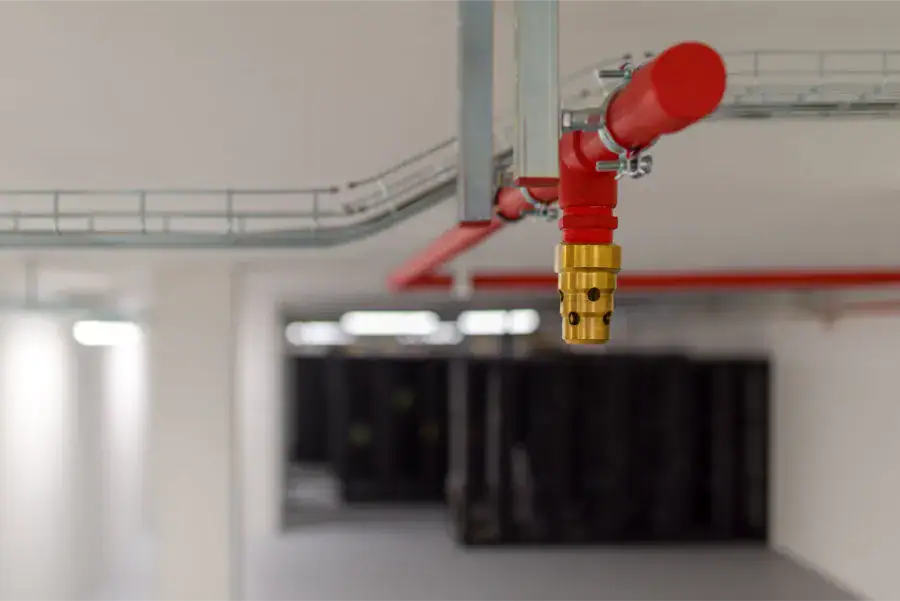
Transformer bays and enclosed rooms are at risk of structural damage if a fire suppression system triggers without adequate pressure management. Gas discharge and arc fault events can create sudden spikes in pressure that exceed the room’s tolerance. Without proper venting, this can not only damage walls, doors, and equipment, but also compromise the effectiveness of the fire suppression system through leaks or loss of gas concentration.
Pressure venting for gas discharge
When an inert or chemical gas fire suppression system activates, the rapid release of gas into a confined space generates a pressure spike. Pressure relief vents are designed to open at the right moment to release excess pressure, preventing structural damage.
Once the peak pressure is relieved, vents close again to maintain enough containment for the gas to suppress the fire effectively. This balance ensures both safety and system performance.
Pressure venting for arc flash events
Arc flashes and arc fault events can produce near-instantaneous, extreme overpressures. Far higher than normal fire suppression events. Pressure relief vents play a critical role in mitigating these blasts, channelling the force away from sensitive equipment and personnel, and preventing blow-outs of walls or doors. Properly engineered venting protects both the room and the suppression system itself.
Testing, certification and long-term performance
Pressure relief venting is a crucial component of any transformer bay fire suppression strategy. Reliable pressure venting requires rigorous validation:
- Independent certification. Ensures vents meet industry standards for both fire suppression and arc blast events.
- Real-world testing. Confirms vents perform as expected under realistic conditions, including multiple discharge scenarios.
- Long-term reliability. Materials, seals, and mechanical components are tested to withstand repeated activation cycles and environmental conditions, maintaining protection over the life of the installation.
Room integrity: Making gas suppression work
Room integrity refers to the ability of a transformer room or enclosure to contain fire suppression gas long enough for it to extinguish a fire effectively. This means that walls, doors, ceilings, and seals must prevent significant leaks while the system is active.
Maintaining room integrity is critical during gas suppression because any uncontrolled leakage can reduce the gas concentration, preventing it from reaching the level needed to suppress a fire. Even small gaps or poorly sealed doors can compromise the system, allowing fire to continue or reignite.
Properly designed enclosures, combined with compliant pressure relief venting, ensure that gas suppression systems work as intended while also protecting the structure from overpressure.
Pressure relief venting with AFP
Transformer bays face significant fire risks due to flammable oils, high electrical loads, and the potential for arc fault events. The most reliable transformer fire protection combines gas-based fire suppression with properly engineered pressure relief venting. This combination prevents structural damage and ensures system effectiveness.
AFP’s range of pressure relief vents is designed to maintain room integrity, manage overpressure from both gas discharge and arc flashes, and provide long-term, certified reliability.
Explore our products to safeguard your transformer areas and ensure your fire suppression systems perform when it matters most.